
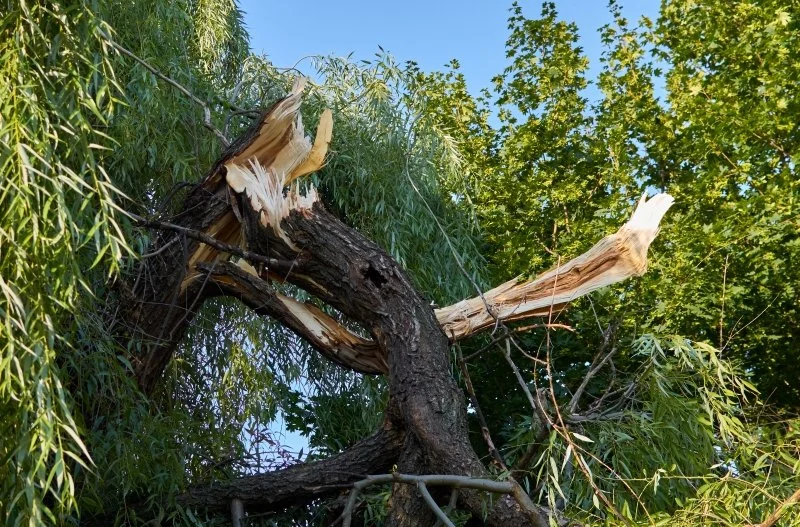
Edmonton homeowners know that summer storms can arrive quickly and leave behind significant damage. High winds, heavy rain, hail, lightning, and sudden temperature changes can transform a healthy-looking tree into a serious hazard within minutes.
A tree that stood safely in your yard for decades can suddenly develop a cracked tree trunk, lose major limbs, split at the base, or fall completely. In some cases, the damage is obvious — a tree across a driveway, branches on a roof, or a trunk leaning dangerously toward a home.
Other damage is much harder to identify.
A tree may still be standing but have internal fractures, compromised roots, or structural weaknesses that make it unsafe days, weeks, or even months after the storm.
For homeowners searching for storm damaged trees Edmonton, understanding what to do immediately, when to call for help, and whether a damaged tree can be saved can prevent further property damage and unnecessary removal.
This guide covers everything Edmonton homeowners need to know after storm damage, including:
What to do within the first 24 hours after a storm
When emergency tree removal is necessary
How insurance typically handles tree damage
Which Edmonton tree species are most vulnerable
Whether damaged trees can recover
Repair versus removal decisions
Storm damage costs
Prevention strategies for future storms
1. What to Do in the First 24 Hours After a Storm
When a major storm passes, the first instinct for many homeowners is to start cleaning up immediately. That can be dangerous. A damaged tree is not the same as fallen branches on the ground. Trees under tension can move unexpectedly, break apart without warning, or shift as damaged limbs continue to fail.
Before grabbing a chainsaw or ladder, follow these steps.
1. Make Sure Everyone Is Safe. Stay away from:
Trees leaning toward homes
Large hanging branches
Split trunks
Trees touching power lines
Branches suspended above walkways or driveways
Areas where the ground appears lifted or cracked around roots
A tree that has partially failed may still be carrying thousands of pounds of weight. The safest decision is often to create distance first and assess later.
2. Check for Immediate Hazards. Ask:
Is the tree touching your home? A tree on house situation requires immediate attention. Trees resting on roofs, garages, vehicles, decks, or structures can continue shifting after the initial impact. Do not climb onto the roof to remove branches or attempt to pull sections away yourself.
Are power lines involved? Never touch: Trees contacting electrical wires, branches near utility lines, fallen trees pulling on service lines. Contact your electrical provider or emergency services if there is immediate danger.
Is the tree leaning differently than before? A sudden lean can indicate root failure, soil movement, trunk cracking, partial uprooting. A leaning tree is not always guaranteed to fail, but after a major storm it should be assessed carefully.
3. Document Damage Before Cleanup. Before removing anything: Take photos and videos of:
The entire tree
Close-ups of cracks or splits
Broken limbs
Damage to buildings or vehicles
Fallen branches
Root lifting
This documentation can be valuable for insurance claims, contractor assessments, and future tree health decisions
4. Avoid DIY Tree Removal After Major Storms. Storm cleanup can seem straightforward and in many cases it can be. However, a branch hanging 20 feet above the ground after a storm can behave differently than it would otherwise. Common hazards include:
Hidden cracks
Compressed wood under tension
Unexpected limb movement
Falling debris
Chainsaw injuries
Chainsaw operation and tree work involve significant risks and require proper training and protective equipment (learn more).
2. When to Call an Arborist After Storm Damage
Not every damaged tree needs removal. However, in many cases, a proper assessment can determine whether the tree can be safely preserved through pruning, support systems, or corrective care.
You should consider calling a tree professional when you notice:
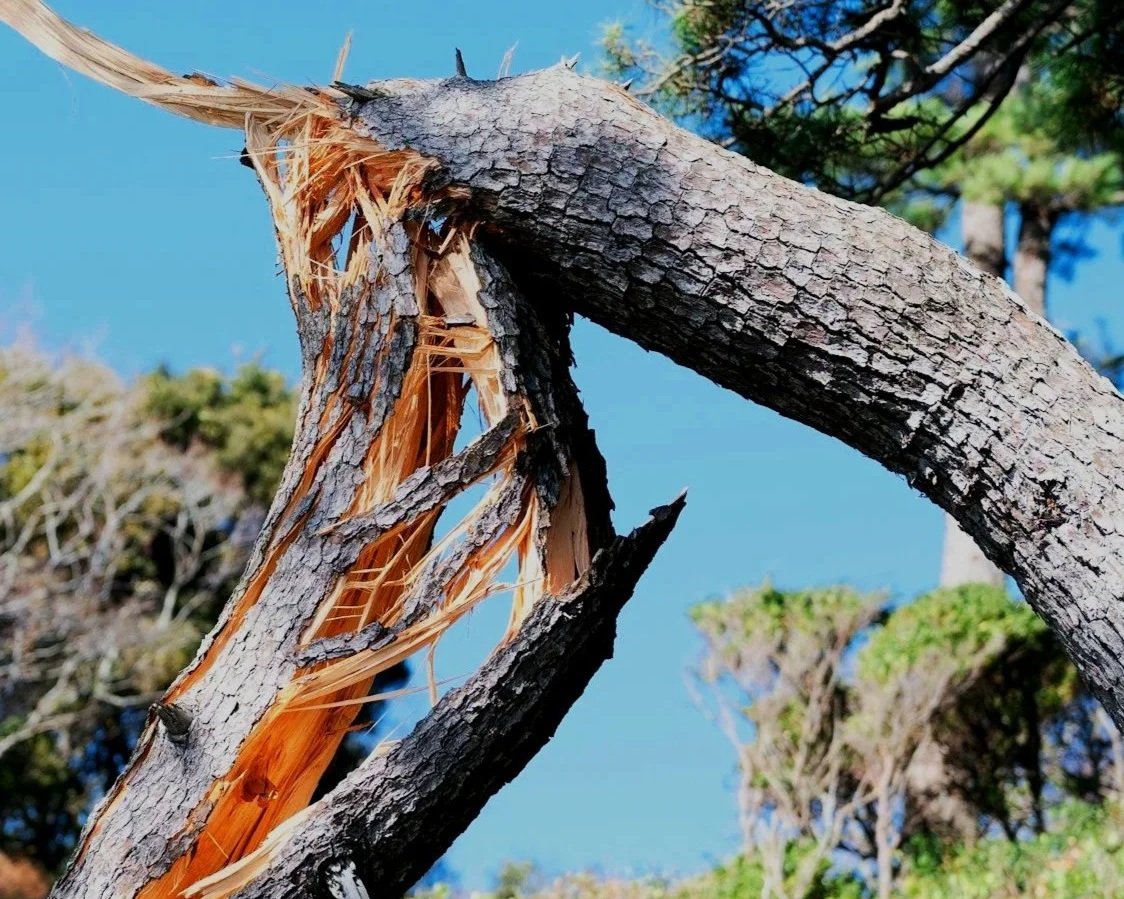
A Cracked Tree Trunk. A cracked tree trunk is one of the most concerning storm-related issues. Trunk cracks can occur because of high winds, heavy snow or ice loading, lightning strikes, sudden twisting forces, and previous structural weakness
Not all cracks mean immediate removal, but their location matters. A crack: extending deep into the trunk, located near a major union, associated with separation or movement, and combined with leaning may indicate serious structural failure.
A Split Tree. A split tree often occurs when two or more major stems separate under wind pressure. This is especially common in trees with included bark, multiple competing leaders, and weak branch unions. Some splits can be stabilized depending on the severity and location. Others create permanent structural weakness.
Large Broken Limbs. Large storm-damaged limbs can create future decay points, balance problems, and other failure risks. A tree may survive losing a branch, but proper pruning can influence whether it recovers successfully.
Root Damage. Root issues are among the most overlooked storm problems. Warning signs include soil lifting around the base, exposed roots, sudden leaning, cracks appearing in the soil, tree movement during wind. A tree with compromised roots may appear healthy but become unstable later.
We’re Here to Help
If you have a storm damaged tree that needs professional attention, we’re here to help.
📍 Book a Free On-Site Assessment
📞 Call or text us us at 780-937-6369
3. When to Call Insurance After Storm Damage
Many homeowners are unsure whether tree damage falls under home insurance. Coverage depends on:
Your specific policy
The cause of damage
Whether property was damaged
Local insurance rules
In many cases, insurance focuses on resulting property damage, not simply tree maintenance.
A healthy tree falls during a storm and damages your roof → often considered a property claim.
A tree is old, declining, or poorly maintained and falls without storm-related damage → coverage may differ.
Always contact your insurer for guidance before making assumptions.
Insurance Tree Damage Documentation Checklist
Before cleanup, gather:
✓ Photos of the tree before removal
✓ Photos of storm conditions if available
✓ Damage photos
✓ Repair estimates
✓ Tree assessment documentation
✓ Receipts for emergency work
Sources for Insurance Information
Homeowners can review general guidance from:
(Always confirm coverage directly with your insurance provider.)
How to Tell if a Tree Is Beyond Saving
One of the biggest questions homeowners ask after a storm is: “Can this tree be saved, or does it need to come down?” The answer depends on several factors.
Trees That May Be Salvageable
A damaged tree may recover if:
The trunk remains structurally sound
Less than approximately one-third of the canopy is lost
Roots remain stable
Damage is limited to branches
The species responds well to pruning
Examples:
Minor branch breakage
Small crown damage
Limited storm pruning needs
Trees More Likely to Require Removal
Removal may be recommended when:
The trunk has severe splitting
Major stems have separated
Roots have failed
The tree is leaning toward structures
Structural damage cannot be safely reduced
A dangerous tree after storm events is not necessarily the tallest or largest tree — it is the tree whose remaining structure cannot safely support itself.
4. Edmonton Trees Most Likely to Fail During Storms
Edmonton has a diverse urban canopy, but some species are more vulnerable to certain types of storm damage. Factors include:
Wood strength
Growth patterns
Age
Previous pruning
Site conditions
Root development
1. Spruce Trees
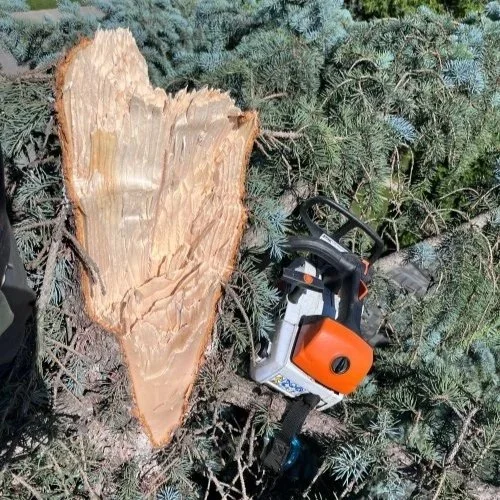
Spruce are common throughout Edmonton yards and neighbourhoods. They are generally strong trees but can experience storm problems due to shallow root systems, heavy snow loading, large exposed crowns, and wind exposure. Common failures include root plate lifting, major branch breakage, and stem failure. Large mature spruce trees in open areas may be especially vulnerable during extreme winds.
2. Birch Trees
Birch trees are popular because of their appearance, but they can be vulnerable. Common issues include weak branch attachments, stem splitting, and decline from environmental stress. Storm damage can accelerate existing problems.
3. Poplar Trees
Poplars are among Edmonton’s fastest-growing trees. Their rapid growth can create large limbs, brittle branches, hollowing from decay, and failure during high winds. Large poplars near homes deserve regular assessment.
4. Ash Trees
Ash trees were once among Edmonton’s most common urban trees. Storm concerns include heavy limbs, structural defects, and declining trees affected by environmental stress.
5. Elm Trees
Elms are often valued for their longevity and canopy. Potential storm concerns include large mature limbs, structural weakness from previous damage, and heavy canopy loading. Proper pruning can reduce future risks.
6. Mountain Ash Trees
Mountain ash can be especially vulnerable when multiple stems develop from a single base. Storm failures often occur when multiple leaders compete, included bark develops, and heavy snow or wind creates leverage. A split mountain ash may sometimes be stabilized, but severe separation can become a significant safety concern.
7. Manitoba Maple
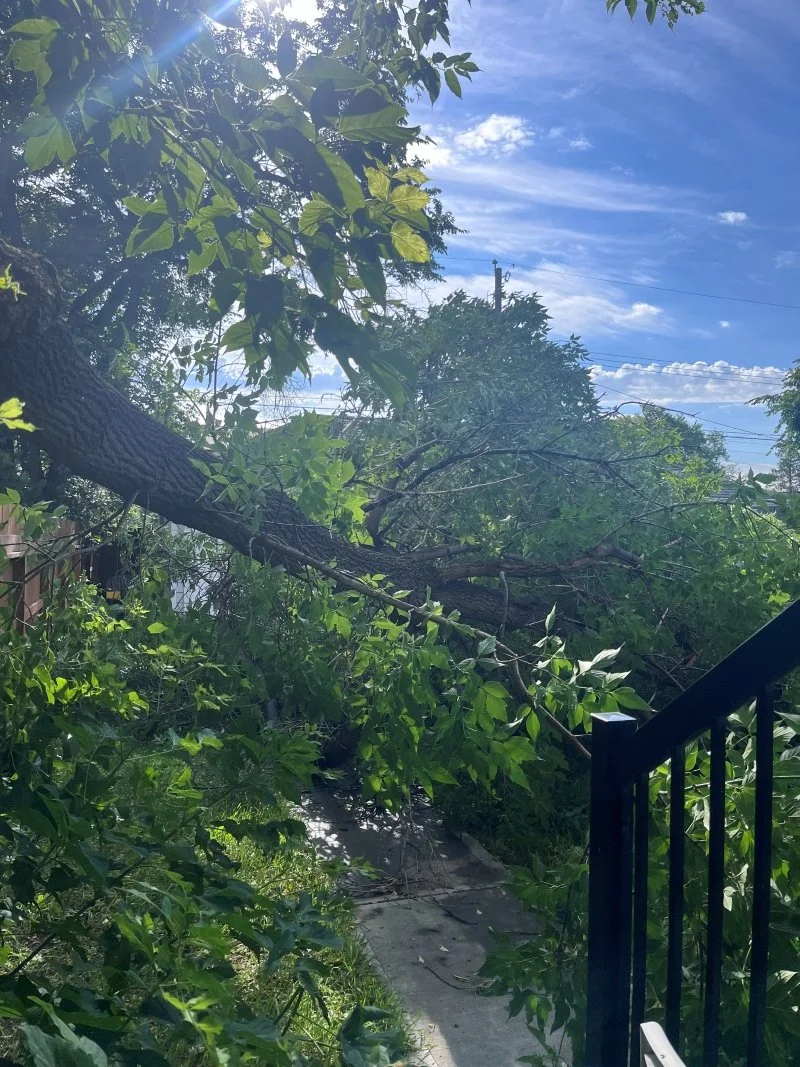
Manitoba maples are fast-growing, hardy trees commonly found in older Edmonton neighbourhoods, but their rapid growth often comes at the expense of structural strength. They frequently develop multiple stems with weak branch unions, making them more susceptible to splitting during high winds or heavy, wet snow. As these trees mature, internal decay can further increase the risk of large limb failures or trunk failure. Following a storm, Manitoba maples should be inspected for fresh cracks, hanging limbs, and signs of stem separation, particularly if they are located near homes, decks, sheds, or driveways.
5. Can Damaged Trees Be Saved After a Storm?
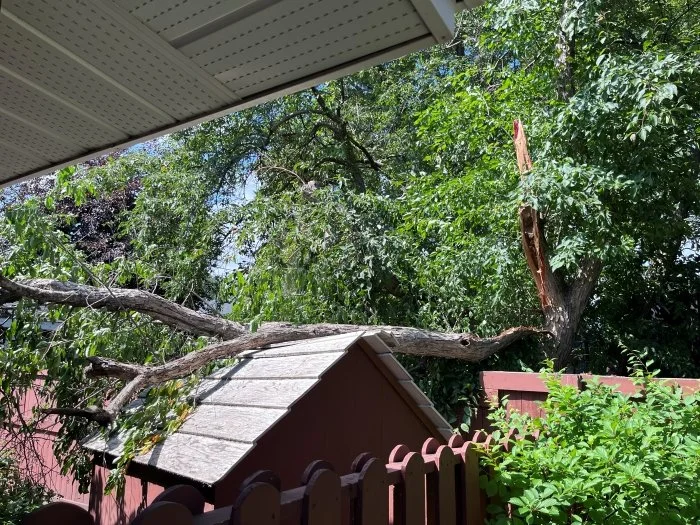
One of the most difficult decisions homeowners face after severe weather is determining whether a damaged tree can recover or whether removal is the safest option. A storm-damaged tree is not automatically a lost cause.
Many homeowners assume that a tree with broken branches, missing sections of canopy, or visible damage must be removed.
In reality, trees are remarkably resilient organisms. Some can survive significant storm damage with proper pruning, monitoring, and corrective care. However, some damage permanently compromises a tree’s structure.
The goal is not simply to save every tree. The goal is to determine whether the tree can remain healthy, structurally sound, and safe for the property around it.
Factors That Determine Whether a Storm-Damaged Tree Can Recover
When assessing storm damaged trees Edmonton, several factors influence whether repair is possible.
1. The Location and Severity of the Damage. Not all damage is equal. A tree that loses smaller branches from the outer canopy may recover well. A tree with a split trunk, a failed major branch union, root failure, extensive trunk cracking, or a broken central leader requires professional assessment. A damaged branch can often be removed. A damaged trunk is much more difficult to correct.
2. How Much of the Canopy Was Lost? A healthy tree relies on its leaves to produce energy. If a storm removes a significant portion of the canopy, the tree may struggle to recover. Generally:
Minor canopy loss → often recoverable
Moderate canopy loss → requires assessment and monitoring
Severe canopy loss → may create long-term decline
Heavy pruning after storms can sometimes create additional stress if too much healthy tissue is removed.
3. The Tree’s Age and Overall Health. A mature, healthy tree may recover from damage differently than a declining tree already experiencing problems. Consider:
Was the tree growing well before the storm?
Did it have previous damage?
Was there visible decay?
Was the canopy thinning before the event?
Was it already leaning?
Storm damage often reveals weaknesses that existed before the storm occurred.
4. The Tree Species. Some species respond better to damage than others. For example:
Certain deciduous trees can compartmentalize wounds effectively.
Some trees with weak wood characteristics may continue declining after major damage.
Trees with naturally weak branch unions may not recover from splitting.
This is why a proper assessment matters.
Split Tree Repair: When Is It Possible?
A split tree repair is one of the most requested services after wind events. Homeowners often ask: “Can you just bolt the tree back together?”
Sometimes the answer is yes. Sometimes it is not.
When Split Tree Repair May Be Considered
Tree support systems such as cabling or bracing may be options when:
The tree has high value to the property
The split is limited
The remaining structure is healthy
The tree can be stabilized safely
The risk can be reduced to an acceptable level
Support systems may help reduce movement between stems and reduce the likelihood of further failure.
When Repair Is Not Recommended
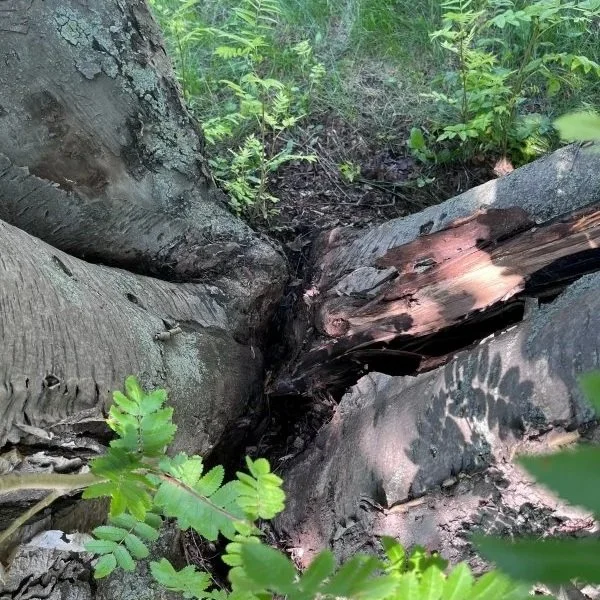
A split tree may need removal when:
The split extends deep into the trunk
The wood is separating significantly
Decay is present
One or more stems are failing
The tree threatens a home, vehicle, or frequently used area
A support system does not restore a tree to its original condition. It is a risk-management tool
Cabling vs Removal: Which Option Makes Sense?
One of the biggest misconceptions homeowners have is that tree cabling “fixes” a tree. Cabling does not repair damaged wood. Instead, it provides additional support that may reduce movement and improve stability in some situations.
Tree Cabling. Cabling may be considered for:
Valuable landscape trees
Trees with structural weaknesses
Multiple stems with poor unions
Trees where preservation is a priority
Benefits can include:
✓ Retaining a mature tree
✓ Reducing movement between stems
✓ Supporting weak branch unions
✓ Extending the useful life of a tree
However, cabling requires ongoing monitoring.
Tree Removal. Removal may be the safer option when:
Structural integrity has been compromised
The tree is likely to fail
The tree threatens structures
Repair would not reduce risk sufficiently
For homeowners searching emergency tree removal Edmonton, the priority should always be safety first. A tree that has failed during a storm may continue failing as weather conditions change.
6. Emergency Tree Removal Edmonton: When Immediate Action Is Needed
Emergency tree removal is typically required when a tree creates an immediate hazard.Examples include:
A Tree on a House. Tree on house situations require careful handling. Potential risks include worsening roof damage, structural movement, additional branches falling, and increased danger during removal. Do not attempt to remove large sections yourself. The weight distribution of a tree resting on a structure can change quickly.
Fallen Tree Removal. A fallen tree may appear harmless because it is already on the ground. However, tension can remain in bent trunks, suspended branches, root balls, and twisted limbs. A fallen tree removal project requires understanding where pressure is stored before cutting.
Dangerous Tree After Storm Events. A dangerous tree after storm may look like sudden leaning, hanging limbs, trunk separation, root lifting, or movement during wind. Homeowners should avoid standing beneath damaged trees while waiting for assessment.
7. Storm Damage Tree Removal Costs in Edmonton
The cost of storm cleanup depends heavily on the situation. There is no universal price because every tree and property presents different challenges.
Factors affecting cost include:
Tree Size. Large mature trees require more equipment, more labour, more time, more safety planning, and even after-hours or priority service costs.
Tree Location. A tree in an open backyard with easy access is generally simpler than one leaning over a roof, tucked between homes, near electrical lines, or against a fence or structure.
Emergency Response. Storm events often create high demand. Emergency services may involve additional considerations because access may be difficult, safety risks are higher, and equipment requirements can increase.
Cleanup Requirements. Removal costs may include cutting and dismantling, branch removal, log removal, stump grinding, and site cleanup.
Get more information about approximate tree service costs.
Why Storm Cleanup Often Reveals Other Property Damage
One unique challenge after Edmonton storms is that homeowners often discover multiple issues at once. A storm may damage:
Trees,
Decks,
Pergolas,
Sheds,
Outdoor structures, and more
A fallen tree can crush structures, while wind and hail can damage exterior materials. This is where a full-property approach can make storm recovery easier.
Instead of coordinating multiple contractors for every issue, our clients benefit from working with a company that understands both tree hazards and exterior property repairs.
“Lance is always my first call for any home or yard reno or maintenance issue. He’s a top-shelf carpenter and arborist, and an amazing troubleshooter. … he will be the first person I call for any household task, big or small, and I recommend him without reservation to anyone looking at doing work around their home.”
8. Storm-Damaged Tree Prevention Checklist
The best time to address tree risks is before the storm arrives. Homeowners can reduce damage by:
Schedule Regular Tree Assessments. Look for:
✓ Cracks
✓ Dead branches
✓ Leaning trees
✓ Decay
✓ Weak branch unions
Remove Dead or Hazardous Limbs. Deadwood becomes especially dangerous during high winds, heavy snow, and ice storms
Maintain Healthy Soil Conditions. Trees are more resilient when they have adequate water, proper mulch, and healthy root zones.
Avoid Improper Pruning. Poor pruning practices can create weak branch attachments, decay pathways, and long-term structural problems.
Check out our post on preventative care to learn more about how you can avoid serious storm damage before it happens.
FAQ: Storm-Damaged Trees Edmonton
Here are some of our most frequently asked questions this 2026 storm season!
-
Not always. Some trees can recover with proper pruning or support. However, trees with structural failure, root damage, or major trunk splits may require removal.
-
Trees do not heal like humans. They compartmentalize damage and grow around injuries, but significant trunk cracks can remain structural weaknesses.
-
Coverage varies. Many policies focus on damage caused by fallen trees rather than preventive removal or tree maintenance. Always confirm with your insurer.
-
Sometimes. Cabling or bracing may help stabilize certain trees, but severe splits may make removal the safer option.
-
If it threatens structures, blocks access, or remains unstable, it should be addressed quickly.
-
Large spruce trees can be vulnerable because of their size, crown structure, and root characteristics, especially in exposed locations. However, just because it is a spruce tree doesn’t automatically make it a threat.
-
Yes. While hail damage is often cosmetic, severe hail can:
Strip leaves
Damage bark
Break branches
Create entry points for disease
-
Keep people away from the area and contact a professional tree service experienced with emergency removals.
Looking for answers to other burning questions? Check out our FAQs page.
Keep yourself and your family safe this storm season!
📩 Request an Estimate
📍 Book an On-Site Assessment
📞 Call or text us us at 780-937-6369